

What is AI SEO? How It's Changing Organic Search in 2026
- The goal in 2026 is to get your content cited inside AI-generated answers on Google, ChatGPT, and Perplexity rather than just appearing in a list of ranked links.
- Structured, credible, and extractable content backed by third-party mentions and schema markup signals to AI models that your brand is worth referencing.
- B2B decision-makers like CTOs and VPs now form vendor shortlists through conversational AI queries before ever visiting a website.
- Technical SEO and domain authority remain essential but need layering with GEO, AEO, and topical authority clustering to stay competitive in AI search.
- Citation frequency, share of model, and AI-generated referral traffic are the visibility metrics that actually reflect how your brand performs in 2026’s search landscape.
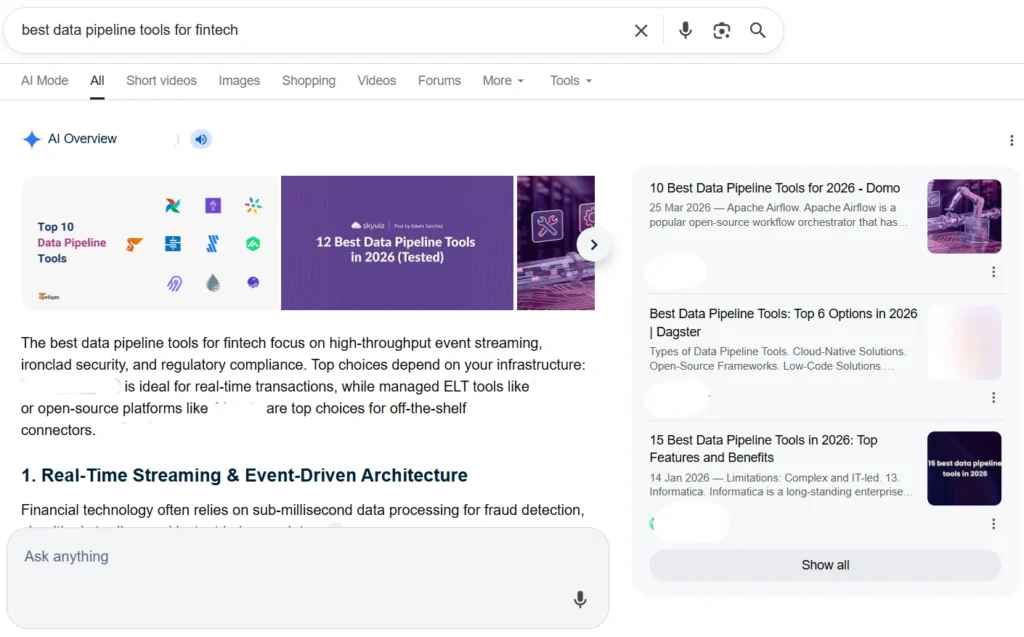
A SaaS buyer types “best data pipeline tools for fintech” into Google and never scrolls past the first section. Not because the answers ran out, but because Google’s AI Overview already handed them a shortlist. Your product could be the right fit, your content could be thorough, and your domain could have solid authority, but if you’re not inside that synthesized answer, the buyer moves on without ever knowing you exist.That’s the reality B2B tech companies are navigating in 2026. Organic visibility no longer belongs to whoever ranks highest. It belongs to whoever AI systems trust enough to cite, and that distinction is what AI SEO is built around.
AI SEO Decoded: What It Actually Means for B2B Tech Teams
AI SEO refers to the practice of optimizing digital content so it gets discovered, extracted, and cited within AI-powered search experiences, including Google’s AI Overviews, Bing Copilot, ChatGPT search, and Perplexity.
Unlike traditional SEO, which focuses on getting a page to rank in a list of ten blue links, AI SEO focuses on making your content the source that AI systems trust and reference when generating answers.
Traditional search engines indexed pages. Modern AI search engines interpret meaning, assess credibility, and synthesize responses from multiple trusted sources. For B2B tech and SaaS brands, this matters enormously because your buyers, CTOs, VPs of Engineering, and procurement leads increasingly start their research with a prompt, not a keyword.
Here’s what sets AI SEO apart from conventional optimization:
| Dimension | Traditional SEO | AI SEO (AEO / GEO) |
|---|---|---|
| Primary goal | Rank on SERPs | Get cited in AI-generated answers |
| Success metric | Keyword rankings, organic clicks | Citation frequency, share of model |
| Content structure | Keyword-dense paragraphs | Clear, extractable, self-contained facts |
| Authority signals | Backlinks, domain authority | Verified expertise, structured data, credibility signals |
| Search behavior | User clicks a link | User reads an AI-synthesized response |
| Discovery path | Ranked URL | Synthesized answer with optional source link |
The Search Behavior Shift That's Rewriting B2B Buying Journeys
The way B2B buyers discover solutions has fundamentally changed. When a VP of Product at a SaaS company searches for “best CRM integration platforms for enterprise,” they rarely scroll through ten links. They read the AI Overview at the top of Google, or they ask ChatGPT and get a synthesized comparison in seconds.
This shift carries direct revenue implications.
Below are the key behavioral changes B2B tech teams need to understand:
- Zero-click is the new norm. Google’s AI Overviews appear in a growing share of informational and commercial queries. Users often get enough from the summary to form a shortlist without clicking a single link. If your brand doesn’t appear in that summary, you’re invisible at the most critical awareness stage.
- LLMs operate on trust signals, not just traffic. Large Language Models like GPT-4o or Gemini don’t rank pages by popularity alone. They extract facts from sources that demonstrate expertise, authority, and verifiable information. A well-structured, credible piece of content from a lower-traffic domain can outperform a high-traffic but vague article.
- Conversational search changes keyword intent. B2B buyers now ask full questions like “What’s the difference between ABM and inbound marketing for SaaS?” or “How do I choose a data pipeline tool for fintech?” These long-form, intent-rich queries demand content that answers comprehensively, not just content that mentions a keyword cluster.
- Multi-platform discovery expands your surface area. AI search isn’t limited to Google. ChatGPT, Perplexity, Claude, and Bing Copilot all serve AI-generated answers to millions of users. Your content strategy must account for visibility across these platforms, not just Google’s SERP.

The New Rules of Ranking: What AI Search Algorithms Actually Reward
AI-powered search systems evaluate content very differently from traditional crawlers. The following are the core signals that determine whether your content gets cited or overlooked in AI-generated responses.
Extractability
AI systems pull discrete, verifiable facts from content. If your key insights are buried in vague paragraphs or hidden behind heavy marketing language, AI systems will pass over them. Content must present information in clear, self-contained units including definitions, statistics, process steps, and comparisons that stand alone without requiring surrounding context.
- Checklist for extractable content:
- Uses clear definitions and direct answers near the top of each section
- Presents data points with source attribution
- Uses FAQ sections, structured headers (H2/H3), and numbered steps
- Avoids vague claims and replaces “many companies” with specific examples or percentages
- Applies schema markup including FAQ schema, HowTo schema, and Article schema
Semantic Depth and Topical Authority
LLM Optimization rewards brands that cover topics comprehensively across multiple content assets, not just a single page. If your SaaS brand publishes one blog about API integration but your competitor has a pillar page, six supporting articles, a comparison guide, and an FAQ section, AI systems will likely pull from your competitor’s ecosystem.
Building topical authority means treating content as interconnected infrastructure. A cluster strategy around your core product categories signals to AI systems that your brand understands the subject space deeply.
Credibility and Trust Architecture
AI systems look for credibility signals that go beyond backlinks. The following are what modern AI search prioritizes:
- Author expertise with named authors, verifiable credentials, LinkedIn profiles, and bios
- Third-party citations through mentions of your brand or content on authoritative external sites
- Structured data with schema markup that explicitly identifies your organization, product, and expertise areas
- E-E-A-T alignment through content that demonstrates Experience, Expertise, Authoritativeness, and Trustworthiness at every layer
Page Experience and Technical Foundations
AI SEO builds on technical SEO rather than replacing it. Fast page load speeds, mobile responsiveness, clean crawlability, and proper canonical tags remain foundational. What’s changed is that these factors now serve both traditional ranking systems and AI crawlers that assess content accessibility at scale.
LLM Optimization in Practice: How to Make AI Systems Cite Your Brand
LLM Optimization is a specific discipline within AI SEO that focuses on how your content is processed by Large Language Models. For companies, getting your brand mentioned in ChatGPT, Perplexity, or Google’s AI Overviews requires a deliberate approach.
Here’s how to execute it:
- Structure content for answer extraction: Every major section of your content should open with a direct answer to the implied question. If you’re writing about SaaS security best practices, the second paragraph should not be a preamble. It should state the answer clearly and then expand. AI systems prioritize content that gets to the point.
- Build a brand mention ecosystem: AI systems learn from the broader web. The more authoritative external sources mention your brand through press coverage, analyst mentions, community discussions, podcast transcripts, and review platforms like G2 or Capterra, the more likely LLMs are to include your brand in relevant responses. PR, thought leadership, and community engagement directly support LLMO.
- Optimize for natural language queries: B2B buyers use conversational prompts. Your content should mirror this by including question-based headers, long-tail FAQ sections, and scenario-based examples. Think about queries like “How does [your product category] help fintech companies scale compliance workflows?” rather than “fintech compliance software features.”
- Use structured data to declare your expertise: Schema markup tells AI systems and traditional crawlers exactly what your content is about. For B2B tech brands, Product schema, Organization schema, FAQPage schema, and HowTo schema are particularly valuable. They provide explicit context that helps AI systems extract and attribute your content accurately.
- Maintain content freshness and accuracy: AI systems deprioritize outdated content. For B2B tech companies in fast-moving categories like cloud infrastructure, cybersecurity, and AI tooling, content that references current data, recent product updates, and timely case studies signals active authority. A content audit every quarter is a core part of AI SEO maintenance.

AI SEO vs. Traditional SEO: A Side-by-Side Reality Check
Many B2B marketing teams still operate on a traditional SEO playbook. Here’s a clear breakdown of where the approaches diverge and what you actually need to update:
- What still works and now works harder
- Technical SEO foundations including site speed, crawlability, and Core Web Vitals
- High-quality, long-form content that comprehensively covers a topic
- Building domain authority through legitimate link acquisition
- Internal linking that signals topical depth
- What’s lost effectiveness
- Keyword stuffing or near-duplicate thin content targeting volume keywords
- Optimizing purely for a number one ranking without considering answer-format content
- Ignoring author credentials and expertise signals
- Focusing entirely on Google while overlooking ChatGPT, Perplexity, and Bing Copilot as discovery channels
- What’s new and non-negotiable
- Generative Engine Optimization (GEO) for structuring content specifically for AI Overview inclusion
- Answer Engine Optimization (AEO) for ensuring your content answers questions in formats AI systems can extract
- LLM Optimization for building brand recognition across the open web so AI models reference you
- Share of model measurement for tracking how often your brand appears in AI responses for relevant queries
How Koda Executes AI SEO for B2B Tech and SaaS Brands
Koda is a full-funnel B2B marketing partner built specifically for growth-focused tech companies. The AI SEO services Koda provides go beyond standard keyword rankings and are engineered to make tech and SaaS brands visible exactly where modern B2B buyers are looking, inside AI-generated responses on Google, ChatGPT, Gemini, and beyond.
Here’s what Koda’s AI SEO approach looks like in practice for B2B clients:
- AI-Ready Content Architecture: Koda audits and restructures existing content to meet the extractability and semantic depth standards that AI search systems require. This includes FAQ schema implementation, pillar-and-cluster topic architecture, and conversion-focused content that earns citations and not just clicks.
- LLM Optimization and Brand Mention Strategy: Koda builds brand authority across the open web through strategic content placement and thought leadership, which are the exact signals that LLMs use to decide which brands get cited in AI-generated answers. For SaaS and fintech brands, this translates to measurable improvements in AI visibility and brand recall.
- Technical AI SEO Audits: Koda’s technical team ensures your website sends the right credibility signals to both traditional search engines and AI systems, covering schema markup, page experience, and content accessibility from structured data implementation to crawl optimization for AI-first platforms.
- Performance Tracking Across AI Channels: Koda measures AI SEO performance with metrics that actually matter in 2026, including citation frequency in AI Overviews, share of model in tools like ChatGPT and Perplexity, AI-generated referral traffic, and conversion contribution from AI-assisted discovery.
Conclusion
Search in 2026 rewards brands that AI systems trust enough to cite. For B2B tech and SaaS companies, AI SEO connects directly to the pipeline because your buyers are forming shortlists before they ever visit your site. The shift from ranking to being cited demands a content strategy built around extractability, topical authority, LLM optimization, and credibility architecture.
Companies that move early on this build a compounding visibility advantage that’s difficult for slower competitors to close. Organic search has always rewarded the prepared, and AI search rewards the structured.
Looking to make your B2B tech brand visible in AI search? Contact Koda today and let’s build an AI SEO strategy that puts your brand inside the answers your buyers are already reading.
Frequently Asked Questions:
1. What is AI SEO and how is it different from traditional SEO?
AI SEO optimizes content for AI-powered search platforms like Google's AI Overviews and ChatGPT, focusing on getting cited in synthesized answers rather than ranking in a list of links.
2. How do Large Language Models decide which brands to mention in AI-generated answers?
LLMs prioritize brands with clear, credible, well-structured content, strong third-party mentions, verified expertise signals, and accurate structured data markup across their web presence.
3. What is LLM Optimization and why does it matter for SaaS companies?
LLM Optimization means making your content and brand recognizable to AI models so they reference you in relevant responses, directly influencing B2B buyers during their early research phase.
4. Does AI SEO replace traditional SEO entirely for B2B tech companies in 2026?
No, technical SEO, domain authority, and quality content remain foundational, and AI SEO builds on those foundations by adding structured data, answer-format content, and multi-platform AI visibility.
5. How can B2B tech brands measure success with AI SEO strategies?
Track citation frequency in AI Overviews, share of model in tools like ChatGPT and Perplexity, AI-generated referral traffic in GA4, and conversion rates from AI-assisted organic discovery sessions.





Sreenidhi K is a Content Writer passionate about creating simple, informative, and research-driven content. She enjoys turning complex ideas into engaging content that connects with readers, delivers value, and makes information easy to understand.